None of the information provided is investment or tax advice. You should always read the associated risks before deciding whether to invest. These can be found on the product pages as well as in our risks overview. Please confirm you have read the information above.
The S&P500 isn't as safe as it looks. Its uninterrupted 15-year run has convinced younger, YouTube-influenced investors it's risk-free, but that "buy the dip" confidence coincides with valuations reaching levels last seen in 1999, which were followed by a lost decade for tracker holders.
UK investors face extra risks Americans don't. A strong dollar versus the pound is another potential headwind, and there's a low-but-real risk of capital controls (Trump's proposed tax on foreign holders of US assets, though dropped from the "Big Beautiful Bill," signals a potential direction of travel).
Why go “all in” on an S&P 500 Tracker? Concentrating 100% of a portfolio in a foreign index is risky at the best of times. But when that index is expensive, the currency is pricey, and geopolitical tension is rising, it is a breathtakingly risky thing to do.
Downing launches new actively managed liquid alternatives fund aiming to deliver 7% to 10%+ per annum and positive returns in most markets. The new MGTS Downing Active Defined Return Assets Fund (‘Active Defined Returns’, the ‘Fund’), is the first fund from its new Liquid Alternatives team.
The Fund is aimed at institutional investors, Discretionary Fund Managers, IFAs and advised sophisticated individual investors, and will primarily consist of UK Government bonds and large-cap equity index options, which provide significant scalability and strong liquidity. It aims to deliver 7% to 10%+ per annum and positive returns in all markets except for a sustained equity market fall (generally more than 35%), over a period of at least six years.
The Fund is the first to be launched by the new Liquid Alternatives Team established by Downing. Collectively, the team has over 125 years of experience and sector knowledge, and includes Tony Stenning, who held senior roles at BlackRock and most recently was CEO of Atlantic House Group; Russell Catley, founder and also a former CEO of Atlantic House Group; Huw Price, a former Executive Director at Santander Asset Management, and Paul Adams, former Head of Cash Equities and Derivatives Sales, Royal Bank of Canada.
The Fund offers investors a compelling building block for multi-asset portfolios, aiming to add consistent and predictable returns, typically secured with a portfolio of UK Government bonds. The unique proposition includes a hybrid approach of using systematic derivative strategies and active management, combining liquid investments with predictable returns, and an equity like risk profile.
Investment strategy: Maximising the probability of delivering predictable defined returns across the economic cycle.
Systematic Liquid Derivatives: Systematic, derivative strategies optimise the equity risk-return profile. The Fund uses rules-based derivative strategies linked to the most liquid, large-cap global equity indices (i.e. FTSE100, S&P500) with the aim of harvesting well-proven consistent returns across a wide corridor of market conditions.
Strong security: The Fund will hold a high-quality portfolio of assets as secure collateral – typically UK Government bonds.
Active benefits: At times, rules-based, passive derivative strategies can underperform when markets move strongly – this is when specialist active management can add incremental gains by monitoring and monetising positions and applying active risk management.
Key benefits
Increased consistency and predictability of returns: Positive returns in all markets except for a sustained equity market fall of more than 35% over at least six years.
Diversification of risk: The Fund’s risk components are diversified across large, liquid equity indices, observation levels and counterparties. Secured with high-quality assets – typically UK Government bonds.
Active management: Our experienced team will actively manage the Fund and its investments to optimise risk and reward for investors.
Russell Catley, Head of Retail, Liquid Alternatives at Downing, said: “Put simply, we focus your investment risk on the probability of receiving the returns you need, not those you don’t. We target the highest probability of delivering 7% to 10%+ per annum with active management adding material incremental gains. We believe that we are building the next evolution of the proven success of Defined Returns funds
The Downing team isseeing strong demand from clients looking for alternatives to large-cap equity funds which are becoming concentrated in technology stocks, or alternatives to UK equity income funds and illiquid alternatives.”
Tony Stenning, Head of Liquid Alternatives at Downing, said: “The launch of our Active Defined Return Assets Fund is a significant milestone in the ambitious build-out of our new Liquid Alternatives strategies. It is a solution-focused fund that should deliver stable high single or low double-digit returns across a wide spectrum of equity market conditions, except for a persistent multi-year bear market. The Fund is designed to enhance balanced portfolios by providing consistent, predictable returns and is suitable for accumulation or drawdown.
“We aim to deliver a unique combination of proven systematic derivative strategies and specialist active management, and we are doing so at a very compelling fee level, below our closest competitors and in line with active ETFs.”
How the Fund is expected to perform in different markets
In bullish markets: UK Government bonds secure the capital, and the equity index options deliver a predictable 7-10%+ return per annum – giving up some less likely upside.
In neutral markets and normal market corrections: UK Government bonds secure the capital, and the index options deliver a predictable 7-10%+ return per annum.
In a sustained sell-off: if markets fall more than the cover to capital loss and do not recover for six years. Then capital is eroded 1:1 in line with the worst performing index.
The average Cover to Capital Loss is targeted at 35%: the average cover to capital loss represents the average level the Global indices within the Fund could fall before capital is at risk.
Fund key risks
Performance: Capital is at risk. Investors may not get back the full amount invested.
Liquidity: Access to capital is always subject to liquidity.
Counterparty risk: Other parties could default on the contractual obligations.
Fund Structure
UK regulated OEIC fund structure, fully UCITS compliant
Daily dealing, at published NAV
Minimum investment: £100,000
SRRI: 6 out of 7
Depositary: Bank of New York
Authorised corporate Director (‘ACD’): Margetts Fund Management Ltd.
I share-class: SEDOL: BM8J604 / ISIN: GB00BM8J6044
F share-class: SEDOL: BM8J615 / ISIN: GB00BM8J6150
Risk warning: Opinions expressed represent the views of the fund manager at the time of publication, are subject to change, and should not be interpreted as investment advice. Please refer to the latest full Prospectus and KIID before investing; your attention is drawn to the risk, fees and taxation factors contained therein. Please note that past performance is not a reliable indicator of future results. Capital is at risk. Investments and the income derived from them can fall as well as rise and investors may not get back the full amount invested. Investments in this fund should be held for the long term.
Important notice: This document is intended for professional investors and has been approved as a financial promotion in line with Section 21 of the FSMA by Downing LLP (“Downing”). This document is for information only and does not form part of a direct offer or invitation to purchase, subscribe for or dispose of securities and no reliance should be placed on it. Downing does not offer investment or tax advice or make recommendations regarding investments. Downing is a trading name of Downing LLP. Downing LLP is authorised and regulated by the Financial Conduct Authority (Firm Reference No. 545025). Registered in England and Wales (No. OC341575). Registered Office: 10 Lower Thames Street, London EC3R 6AF.
The S&P500 is not the Holy Grail (it’s a very naughty index)
The same thing’s cropped up in conversation with a few of you recently; clients asking why their adviser doesn’t just save a load of hassle and cost by putting everything into an S&P500 tracker. And these aren’t young clients, from whom you might expect that kind of question, they’re retirement age (or close to it). So that’s what I’ll address in this letter; is this a fair question?
Well, yes, it’s fair to ask. And I understand why they’re asking it, but it won’t surprise you to hear that I think that doing that – going all in on the S&P500 – is a potentially dangerous mistake. I’ll explain why, starting with what (or who) sparked the notion in the first place.
Under the Influence
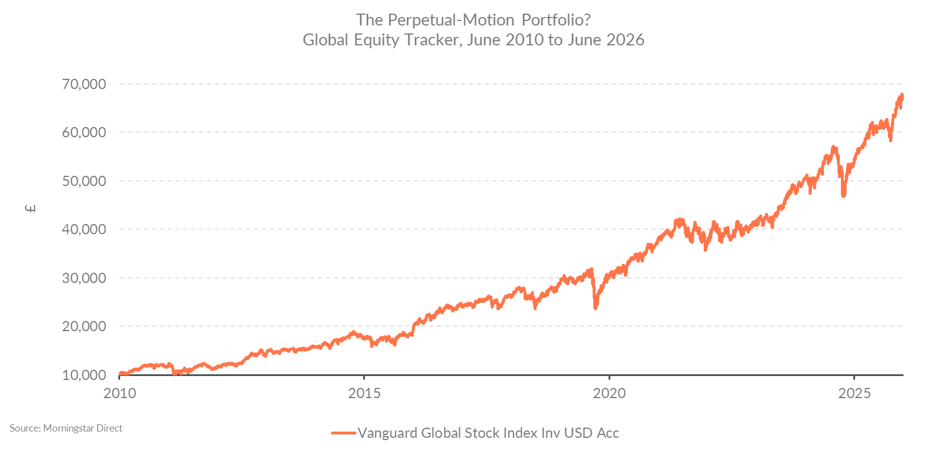
From what I’ve been told, the seeds were planted by the clients’ kids or grandkids, who themselves learned it from influencers on YouTube/TikTok/Insta/Whatever. It’s easy to understand why they think this is such a good idea from the chart below. That’s anS&P500 tracker fund over the last 15 years. It’s gone up almost uninterrupted, which is great. But this kind of stability changes assumptions and behaviours. If you’re under the age of 33, for example, for all of your adult life this is all that ever happens: The S&P goes up.
Source: Morningstar and Downing Fund Managers. Total Return, in GBP terms. 01.07.2010 to 30.06.2026
Past Performance is not a reliable indicator of future performance.
And sure, there are always old codgers out there - like me - banging on about diversification, valuation, and all that old-timey stuff. The trouble is, if they heeded the Young Gun Brigade’s advice a few years back by diversifying (into different markets or asset classes), it didn’t pay off. They’d have been much better off sticking it all on one thing: The S&P500.
Which means, to them, it feels like they’ve (sort of) scientifically tested this theory over a long period of time, most likely the last five years. Because if you’re 28, five years is a long time. And in the last half-decade you’ve seen the back of Covid, the Ukraine Invasion, an inflationary bond market crash, Liberation Day and the Iran War. Each time, the S&P 500 has dipped alarmingly, but then bounced right back, leaving all other markets and assets trailing in its wake. This is why “Buy the Dip” has become a Gen Y/Z motto.
But this is how The Cruel God of markets operates. If you’re not familiar with this mischievous deity’s work (and I strongly suspect that you are), it’s enough to know that his favourite trick is to lure as many people into a financial trap as possible, then slam it shut. And this is one of his lures: Each one of those temporary dips creates the impression that theS&P500 is risk free. Whereas other assets, like say bonds or UK equities, look riskier because they’ve had serious setbacks.
But you should be fearful of things that everyone assumes to be safe. In the equity world, one reason for this is valuation risk. If everyone starts buying one thing – the S&P500 - because it’s the “obvious” thing to buy, it pushes its price upwards, so you get less for your money. This is what happened in 1999, and as you can see from the chart below, it’s where we are today too:
Source: Downing Fund Managers & Robert J Shiller, CAPE Ratio, Jan 1881 to Jun 2026.
Past Performance is not a reliable indicator of future performance
So the S&P 500is just about as expensive as it’s ever been. The last time it got this pricey, this is what happened next:
Source: Morningstar Direct, GBP terms 01.01.2000 to 31.12.2012.
Past Performance is not a reliable indicator of future performance
That’s more than a decade to break even from your initial investment. If a box-fresh influencer thinks five years is a long time, let’s see how they cope with double that – all spent underwater. That’s as long, for the record, as it took Odysseus to get home after the Trojan War, and they made poems and movies about that.
But I suppose your average finfluencer has time on their side, so maybe they’ll be OK. But if, like most of your clients, you’re older and within thinking distance of retirement? Ouch.
So no, the S&P500 doesn’t just go up. It can go down too. And severely so. And these things come in waves. It’s a cycle: A prolonged period of outstanding returns causes more and more people to pile in, which drives valuations to unsustainable levels. It then takes an equally long period of indigestion to wash it all through, as people take the opposite view: Why would you put anything in that?! Those long waves are what this chart shows:
Source: Aswath Damodaran, NYU Stern School of Business (updated Jan 2026); BLS CPI-U
Past Performance is not a reliableindicator of future performance
Ok, let’s calm things down. I’m not predicting an imminent crash, or that there’ll even be a crash at all. There might be, but then there might not; the future’s not written and trying to time such things is impossible without a huge slice of luck.
That said, there’s more risks involved than simply overvaluation and the swings of the stock market.
We’re not American
I don’t know which influencers it was doing the influencing, but I wouldn’t be surprised if they were American. Or, even if they’re not American, that they think they are: Thanks to social media, nationality identities have become more blurred for younger generations, as evidenced by them being more engaged by American political events than British ones (theirs are usually more exciting, to be fair).
If they are American, they don’t have to worry about two other risks that we Brits do. One of those is currency, because if the dollar weakens, they’ll be fine. But UK investors will take a hit from that, even ifthe stock market stands firm. And, as we stand, the US dollar is unusually strong versus the pound (I felt this on my recent trip to New York, the cost of which nearly reduced me to tears). Doesn’t mean it’s about to reverse, of course – but doesn’t mean it won’t, either.
And secondly, for the first time in a long time, there’s a low but meaningful risk of capital controls. These are government-imposed restrictions on the flow of money into or out of a country. President Trump raised the spectre of this, in the form of taxing foreign holders of American assets by proposing it as part of his Big Beautiful Bill. Thankfully it didn’t make the final cut, but it shows how money-strapped policy makers beginning to get desperate. It would sting to lose some of your capital to a foreign tax, or to have it trapped overseas for a period of time should international tensions spike.
This kind of thing is a risk again, having been dormant for decades. To be clear, I think it’s currently a low risk, but I still wouldn’t fancy taking it with 100% of my pension.
So that’s my hot take on the current hot take: By all means hold an S&P500 tracker, but put everything in it? And to do so when it’s nose-bleedingly over-valued, the US dollar’s expensive, and international tensions are rising? (And at a time when your home market looks like a bargain?)That is, frankly, a breathtakingly risky thing to do.
The S&P500 isn’t the holy grail financial influencers think it is: Think twice.
Good luck out there,
Simon Evan-Cook
Fund Manager, MGTS Downing Fox Funds
Opinions expressed represent the views of the fund manager at the time of publication, are subject to change, and should not be interpreted as investment advice.
Important notice: this document has been prepared for professional investors and has been approved as a financial promotion by Downing LLP (“Downing”). Capital is at risk and investors should note that their investments and the income derived from them can fall as well as rise and investors may not get back the full amount invested. Downing does not offer investment or tax advice or make recommendations regarding investments. Downing is a trading name of Downing LLP. Downing LLP is authorised and regulated by the Financial Conduct Authority (Firm Reference No. 545025). Registered in England and Wales (No. OC341575). Registered Office: 10 Lower Thames Street London EC3R 6AF.